SummitET Offering Training and Exercise Support at Huntsville-Redstone Arsenal Conference

SummitET Offering Training and Exercise Support at Huntsville-Redstone Arsenal Conference

SummitET industry experts are attending the Huntsville-Redstone Arsenal Conference in Huntsville, Alabama on October 17 and 18, 2023. The small business contracting conference and expo connects new and seasoned state and federal contractors and offers “best practices” seminars and workshops that enhance knowledge and strengthen relationships in the government procurement space.

SummitET holds government contract vehicles that enable them to provide technical, programmatic, and engineering support services to the Department of Energy/National Nuclear Security Administration (DOE/NNSA). Additionally, they are a subcontract team member for DTRA’s Assessment, Exercises, Modeling, and Simulation Support (AEMSS) multiple award contract and can provide a vast array of preparedness training and exercise services to the Department of Defense and other agencies.

“As an ISO 9001 certified business, quality of our services and client satisfaction are of utmost importance,” said John Duda, CEO of SummitET. “Our team of experts works tirelessly to ensure that we are delivering the best possible solutions to our clients, and we understand the importance of being able to pivot to meet government clients’ objectives and changing requirements.”

Von Braun Center in Huntsville, AL

Exercise and Training Support

  • CBRNE Preparedness
  • FBI/WMD Policy Support
  • Strategic Communications Training
  • Technical Consulting

See Our Preparedness Capabilities

Experts at Our Booth

Meet our experts at Booth A24 to discuss training and exercise support to help prevent, protect against, mitigate, respond to, and recover from manmade and natural threats and hazards.

Dave Raymond, Law Enforcement/CBRNE Senior SME at SummitET

Dave Raymond

Law Enforcement and CBRNE Senior SME

Jim Dougal, Law Enforcement and Tactics Subject Matter Expert for SummitET

Jim Dougal

Law Enforcement and Tactics Subject Matter Expert

SummitET News

SummitET Relaunches Previstar® with Major AI Enhancements

SummitET Relaunches Previstar® with Major AI Enhancements

Summit Exercises and Training LLC (SummitET®), a leader in crisis and emergency preparedness solutions, today announced its acquisition of Previstar® Continual Preparedness System (CPS), a proven emergency management software platform. The acquisition marks a...

read more
SummitET Experts to Attend 2023 National Homeland Security Conference (NHSC)

SummitET Experts to Attend 2023 National Homeland Security Conference (NHSC)

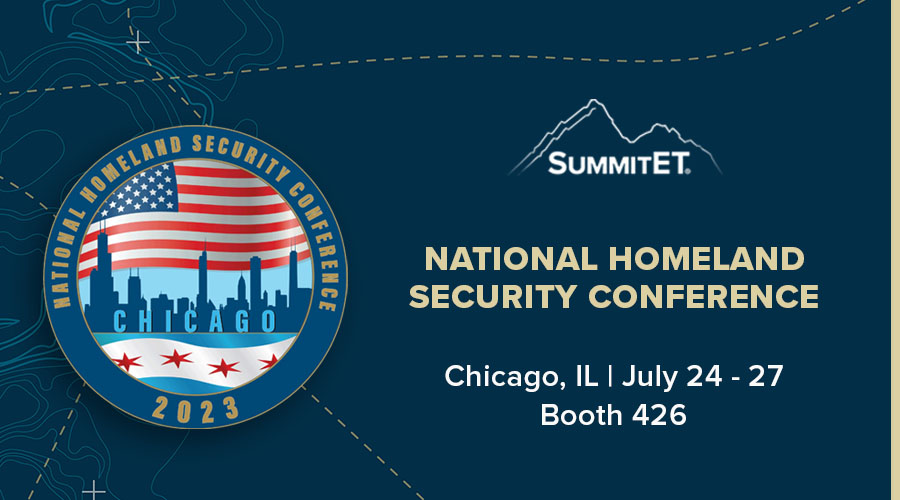
Summit Exercises and Training LLC (SummitET®) experts are attending the 2023 National Homeland Security Conference (NHSC) and trade show in Chicago, Illinois from July 24 to 27.

The NHSC brings together professionals in Homeland Security, Law Enforcement, Fire and Emergency Management to learn about emerging trends in homeland security and see the new equipment, technology, and resources available to enhance their mission objectives.

In support of the Urban Area Security Initiative (UASI)’s emergency management needs, SummitET leverages global experience and public, private, and military subject matter expertise to provide exercise and training support in the areas of counterterrorism, weapons of mass destruction (WMD), and chemical, biological, radiological, nuclear, and explosive materials (CBRNE).

National Homeland Security conference

SummitET’s trainers and program management professionals offer knowledge and know-how with real world event and response experience. Our expert backgrounds include law enforcement, fire services/EMT, emergency management, Federal Bureau of Investigation, Homeland Security, strategic communications, and more.

Conference attendees can connect with SummitET experts to discuss preparedness solutions for current and emerging threats including exercises, training, and plan development with interagency coordination.

Visit Our Booth

Find SummitET experts at the NHSC tradeshow booth #426 where you can learn more about how we can help prepare your agency or organization. Play our interactive game to win preparedness giveaways including t-shirts marked with the SummitET tagline “Preparedness is not an accident®”.

See Our Preparedness Capabilities

Experts at Our Booth

Come visit us at booth #426 in Chicago this July.

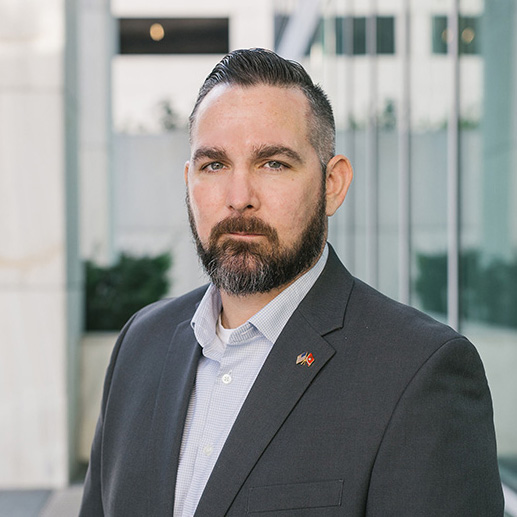
John Duda, Chief Executive Officer and founding partner at SummitET

John Duda

Chief Executive Officer and Founding Partner

Ron Crane

Ron Crane

Director of Programs Quality Assurance &
Program Manager, Isotope Crossroads

SummitET News

SummitET Relaunches Previstar® with Major AI Enhancements

SummitET Relaunches Previstar® with Major AI Enhancements

Summit Exercises and Training LLC (SummitET®), a leader in crisis and emergency preparedness solutions, today announced its acquisition of Previstar® Continual Preparedness System (CPS), a proven emergency management software platform. The acquisition marks a...

read more
Bridging the Gap Episode 2: Stolen Radiation Sources

Bridging the Gap Episode 2: Stolen Radiation Sources

SummitET Subject Matter Experts interpret the emerging threat discussed in the following article. 

Three months, three missing radioactive items. Here’s what you need to know” by Tara Subramaniam

CNN.com, March 31, 2023 

non destructive testing

The recent articleThree months, three missing radioactive items. Here’s what you need to know provides an overview of the recent loss of regulatory control of three items containing radioisotopes in Thailand, Australia, and the United States. The article offers examples of how radioisotopes are used in commercial applications, discusses their associated hazards, and addresses the frequency of loss of regulatory control as seen in these three cases.

Radioactive Isotopes Uses

Radiological materials are used for beneficial purposes across the nation and the world daily – in medicine, research, and industrial applications. These materials are important for diagnosing and treating medical conditions like cancer or to ensure that the integrity of infrastructure like roads or pipelines are verified before beginning construction or use.  

The nature and use of radioactive materials in devices vary. In the U.S., radioactive materials are highly regulated, and the level of regulation, security, and oversight is based on the potential risk posed from the sources within the device. The U.S. Nuclear Regulatory Commission (NRC) and 39 Agreement States work together to ensure that all radioactive materials are properly licensed and used across all industries.

Industrial Radiography Camera

The industrial radiography camera, like the one that went missing recently in the U.S., is one common device that has greater regulatory oversight due its use as a high activity source. It is used in industrial settings for various types of non-destructive testing, but most commonly it is used to image welds or other structural integrity of pipes or metal structures. Most of these devices use an Iridium-192 (Ir-192) source which emits strong gamma photons that are needed to penetrate through the metal to create the images used to look for cracks or defects in the welds, among other purposes. Thousands of industrial radiography jobs are safely conducted across the nation every year.

The Ir-192 source is kept inside a very robust, shielded container, about the size of a shoebox, except when the imaging is occurring – then it is cranked out of the shield through a long tube to expose the film around the pipe or weld of interest. The source is only outside of the shielded housing for 30 seconds to a minute at a time and under very controlled settings carefully managed by the trained operators. This operator training, as well as the requirements for storage, security, transportation, and general use of the device, is outlined in regulations, and the NRC and Agreement States work closely with the licensees who are using these devices.

Theft or Loss of Radioactive Materials   

Bottom-line, individuals can’t just go and purchase or use an industrial radiography camera or other higher activity source without meeting stringent regulations that include significant site security and background checks on those employees with access to the materials.  

However, as indicated in the article, accidents sometimes happen. When they do occur, immediate notification is required, the regulatory agencies actively coordinate with the licensee and any other appropriate agencies to locate the source and oversee any regulatory enforcement actions necessary to prevent other issues from occurring.

Prevention 

Sources can go missing by accident or by act of terrorism but in either scenario it is important that agencies are prepared to prevent and mitigate this risk. Preparing via the development of intelligence information sharing pathways, by creating specialized plans for communications, and other lifesaving tactics are what SummitET’s experts focus on when creating tailored solutions including exercises and training. Learn more how experts can help your agency be at its most prepared.

Contributors:

Angela Leek, Director of Radiological Solutions and Regulatory Affairs

Angela Leek, CHP

Director of Radiological Solutions and Regulatory Affairs

Andrew Manson Law Enforcement and CBRNE Subject matter expert

Andrew Manson

Law Enforcement/CBRNE SME

Justin walker law enforcement and SWAT Subject matter expert

Justin Walker

Law Enforcement SME/Retired Phoenix Police Officer/SWAT Operator; Lead RSARex SME

Kevin Quigley, CBRN and WMD Subject Matter Expert at SummitET

Kevin Quigley

All Hazards SME

Bridging the Gap IAEM Series Episode 14 with Emergency Management Students

Bridging the Gap IAEM Series – Episode 14: The Student Perspective on Emergency Management

In this special IAEM Conference Series episode of Bridging the Gap, SummitET podcast host and former emergency manager Ron Crane meets with Massachusetts Maritime Academy students about their experiences studying and interning in Emergency Management and their perceptions regarding challenges in the field.

SummitET Bridging the Gap Podcast IAEM Series Kenn Honig

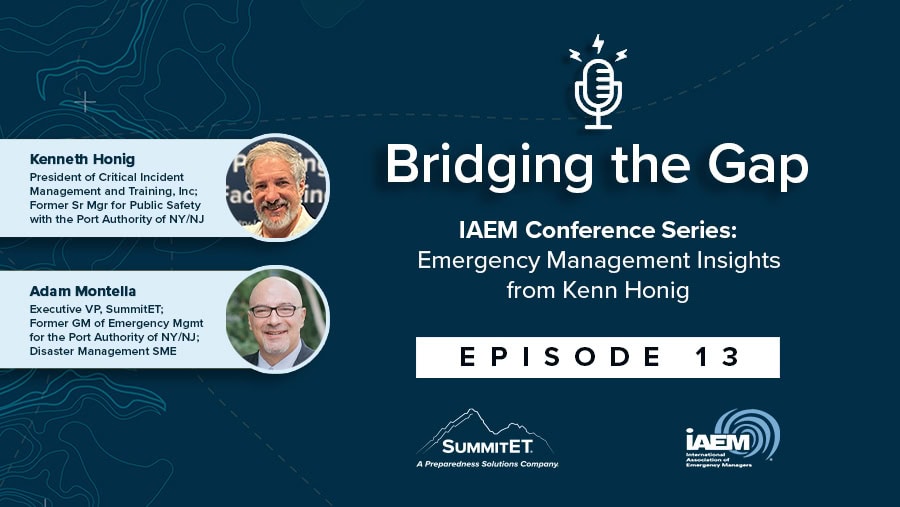
Bridging the Gap IAEM Series – Episode 13: Emergency Management Insights from Kenn Honig

In this special IAEM Conference Series episode of Bridging the Gap, SummitET host Adam Montella is joined by Kenn Honig, a seasoned emergency management consultant with a long career in law enforcement and emergency management at the Port Authority of New York and New Jersey. Join this insightful discussion as they navigate the evolution of emergency management practices, the technological advancements over the decades, and the undeniable importance of personal contacts in the field.

SummitET Bridging the Gap podcast IAEM series Episode 12 DC Metro Emergency Management

Bridging the Gap IAEM Series – Episode 12: D.C. Metro Area Emergency Management

In this special IAEM Conference Series episode of Bridging the Gap, Shannon McCrone, TT&E Program Manager with the U.S. House Sergeant at Arms and Ron Benedict, Readiness, Response and Resiliency Program Manager with DC Department of Health share their experiences, challenges, and ideas for improvement in emergency management in the DC metro area.

Bridging the Gap IAEM Series Podcast Episode 11 Preston Wilson and Dam Safety

Bridging the Gap IAEM Series – Episode 11: Preston Wilson and Dam Safety

In this special IAEM Conference Series episode of Bridging the Gap, host Ron Crane with SummitET is joined by Preston Wilson, CEO of Resilience Solutions Consulting. Prior to this role, Preston was the training manager for FEMA’s National Dam Safety Program, where he was responsible for developing and delivering training on emergency management and dam safety nationwide.

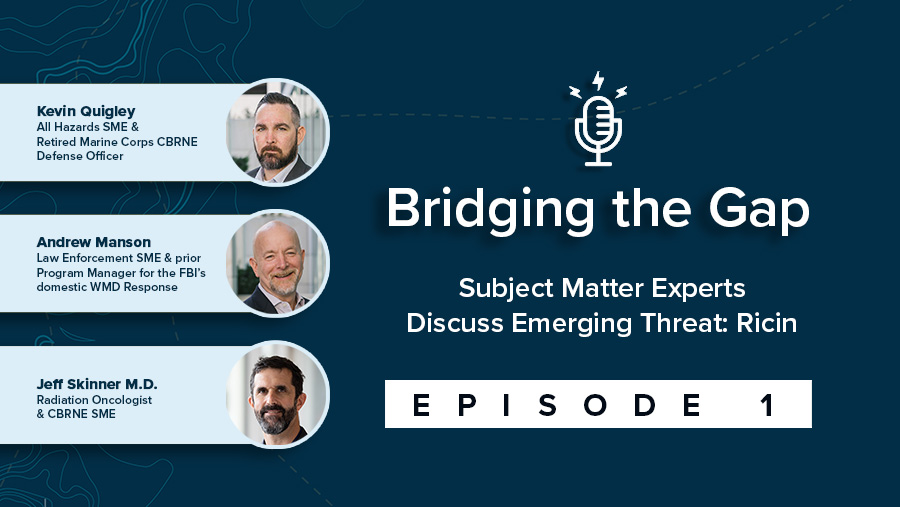
Bridging the Gap Episode 1: Bioterrorism and Ricin

Bridging the Gap Episode 1: Bioterrorism and Ricin

SummitET Subject Matter Experts interpret the emerging threat discussed in the following article. 

Ricin’s Round Two: Germany Prevents Another Islamic State-Motivated Bioterrorism Attack” by Herbert Maack

Terrorism Monitor, Volume: 21 Issue: 5, March 10, 2023

biological threat mitigation

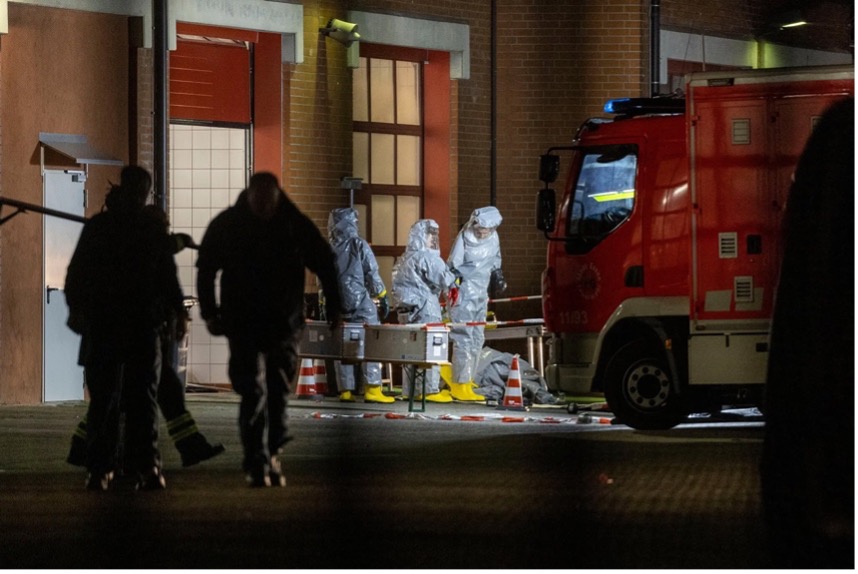
According to Herbert Maack’s Terrorism Monitor article “Ricin’s Round Two: Germany Prevents Another Islamic State-Motivated Bioterrorism Attack,” Germany has experienced multiple ricin bomb threats in the last five years. A terrorist plot in 2018 had the capability to kill over 13,000 people but was disrupted thanks to U.S. intelligence passed to German law enforcement. This past January, German officials faced another possible ricin chemical attack. According to the media, the 2023 attack was postponed by the terrorists due to their lack of a critical toxic substance, and officials were able to intercept the suspects before loss of life occurred.

What is Ricin?

Ricin is a naturally occurring toxic substance that was discovered in 1888 by German scientist Peter Herman Steelmark. It is extracted from castor beans or from the waste materials generated during the production of castor oil, and its final form can be a white powder, mist, or pellet. Castor oil has many medicinal, industrial, and pharmaceutical uses. It’s commonly used as an additive in foods, medications, and skin care products, as well as an industrial lubricant and biodiesel fuel component. Poisoning by the ingestion of castor beans themselves is rare, as they have a hard coat which prevents the release of the ricin toxin.

castor beans

Toxicity and Biological Threat

Ricin is very toxic and is a bad actor when it comes to eukaryotic cells or mammals like us, because it affects all cells. Essentially, it’s two proteins that are linked together. There’s an action chain and the AB chain, or binding chain. They’re linked together with a bond known as a Type 2 ribosome-inactivating protein (RIP). What does that mean? It means it will prevent the body’s cells from making necessary proteins. It’s a poison that impacts the structure, function, and regulation of cells it interacts with making it an incredibly lethal mechanism of killing and damaging cells when inhaled or ingested. Though it may not be all bad, scientists are actively researching ricin as a cancer therapeutic to find a way to target cancer cells with ricin.


Historical Threat

Historically, ricin has been used much more as an assassination tool or poison rather than in terrorist attacks on large groups of people. The most famous assassination was in 1978 in London, where a Bulgarian dissident was waiting at a bus stop when he felt a pain in his leg where he noticed someone had bumped him with the tip of an umbrella. Later that night he developed a fever and irritation at the site of the injury but wasn’t aware yet of its severity. His symptoms worsened and he died at the hospital three days later. During his autopsy they found a tiny pellet that had been injected into his leg via the umbrella. The pellet was hollow and medical experts believed that it was filled with ricin.

While ricin is not a typical biological WMD that first responders face, in the early 2000s there were a number of reported incidences of white powder threats, believed to be ricin, and it does continue to be a problem. You see it on the first responder side from HAZMAT technicians for various ideations of terrorism, criminals, state sponsored programs. So, while not common, ricin as a biological weapon is definitely a threat, and it is deadly.


Symptoms and Treatment

Some initial symptoms from ricin exposure include progressive shortness of breath, irritation at the entry site, possible nausea, or vomiting. Symptoms may occur as early as 3 to 4 hours and will rapidly progress over 12 to 24 hours. The rapid progression of symptoms is what differentiates ricin poisoning from other common illnesses (colds, foodborne illness) that have similar initial ailments.

Recognizing this timeline is very important for responders, and they must coordinate and communicate well with law enforcement and confirmatory labs.

There is no antidote to ricin poisoning. If exposed, seeking medical attention immediately is paramount, as there may be measures taken to try to remove the ricin from the body or provide supportive care. Death can occur within 36 to 72 hours depending on the level and type of exposure.

A significant challenge to treating ricin poisoning is being able to quickly identify whether you’ve been exposed or not. There may be a 12 to 24 hour period before you realize you’ve been exposed and that’s where the real damage comes in. Some testing does exist at a medical facilities if they suspect ricin, but the level of uncertainty is typically high. The exposure to an unknown toxin with some vague symptoms creates a real problem for medical treatment.


Response

Mass panic is a big concern with any type of CBRNE event. With ricin and other deadly toxins, the greater concern is loss of life. It’s important for agencies and government responders to train for bio-terrorism threats like ricin. The U.S. military does train civil support teams; Marine and Army CBRNE defense routinely train for chemical and biological toxins. These are some of the considerations when responding to a ricin terror threat:


Protective Equipment

Responders should consider the use of personal protective equipment such as respirators, suits, gloves, and eye protection. Because ricin is a toxin derived from a living organism, detection is more challenging than other chemicals.

Decontamination

Anyone going into the hot zone for identification, sampling, and monitoring needs to be decontaminated  on the way out.

Communications

Strategic communications teams are responsible for keeping the public informed to help mitigate panic.

Intelligence

Typically, tips from the public is what brings in the most intel, i.e. see something, say something. Tripwires, as the FBI calls them, are also common. An example of this is where companies that sell castor beans report suspicious purchases to authorities.

Field Testing

The difficulty in detecting the presence of ricin means that field testing is not as reliable as confirmatory testing. Field testing often results in more false positives and you have only a 12 hour period to take and send samples to testing.

Exposure

Meanwhile, you need to categorize people into definitely exposed, likely exposed, maybe exposed, or definitely not exposed. Some may need monitoring and some of the symptoms that you may observe in the initial hours could be related to the psychological component of threat exposure. It is critical for responders to be educated in the realities of ricin exposure and to understand the psychological component for the exposed individuals and their family, because there are limited treatment options.

Exercises and Training

Exercising and training this type of scenario will help to prepare response agencies, local government, or state government has for this type of event. It allows agencies to understand current knowledge, strengthen information sharing pathways, and build a cross agency plan. Consistent training will help to validate that plan to then refine it as threats emerge and evolve.

Preparedness experts like those at SummitET can assist in the process to review your plans, identify any gaps, help you revise the plan, and then exercise it. Tabletop exercises are typically done first with all agency participants in one meeting space. This includes people from Hazmat, fire, law enforcement, and the medical community. The action at the site makes all the difference in terms of limiting some of the concerns and understanding what type of decontamination and protective equipment that you need.

Knowledge is power in preparing for biological exposures and providing confidence on-site. There is no such thing as overkill in preparedness, because there’s no safe level of horizon, and preparedness is not an accident.


Contributors:

Andrew Manson Law Enforcement and CBRNE Subject matter expert

Andrew Manson

Law Enforcement SME and prior program manager for the FBI’s domestic WMD response

Kevin Quigley, CBRN and WMD Subject Matter Expert at SummitET

Kevin Quigley

All Hazards SME and retired U.S. Marine Corps Chemical, Biological, Radiological, Nuclear, and Explosives (CBRNE) defense officer

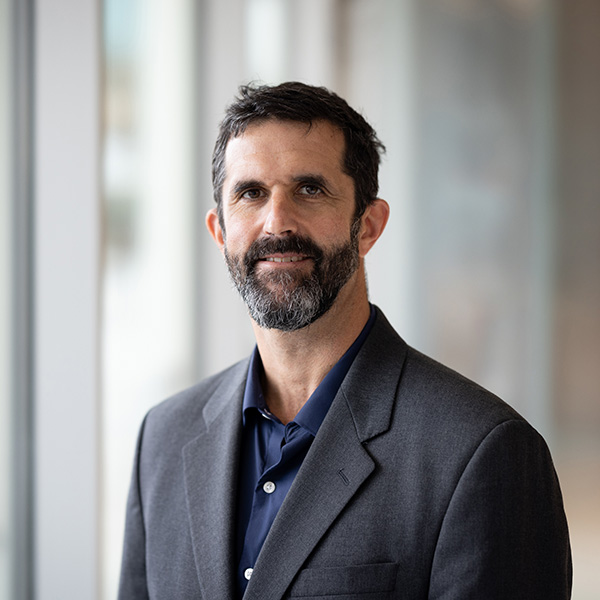
William "Jeff" Skinner, M.D.

Jeff Skinner, M.D.

Radiation Oncologist and Chemical, Biological, Radiological, Nuclear, and Explosives (CBRNE) SME

Bridging the Gap IAEM Series Episode 14 with Emergency Management Students

Bridging the Gap IAEM Series – Episode 14: The Student Perspective on Emergency Management

In this special IAEM Conference Series episode of Bridging the Gap, SummitET podcast host and former emergency manager Ron Crane meets with Massachusetts Maritime Academy students about their experiences studying and interning in Emergency Management and their perceptions regarding challenges in the field.

SummitET Bridging the Gap Podcast IAEM Series Kenn Honig

Bridging the Gap IAEM Series – Episode 13: Emergency Management Insights from Kenn Honig

In this special IAEM Conference Series episode of Bridging the Gap, SummitET host Adam Montella is joined by Kenn Honig, a seasoned emergency management consultant with a long career in law enforcement and emergency management at the Port Authority of New York and New Jersey. Join this insightful discussion as they navigate the evolution of emergency management practices, the technological advancements over the decades, and the undeniable importance of personal contacts in the field.

SummitET Bridging the Gap podcast IAEM series Episode 12 DC Metro Emergency Management

Bridging the Gap IAEM Series – Episode 12: D.C. Metro Area Emergency Management

In this special IAEM Conference Series episode of Bridging the Gap, Shannon McCrone, TT&E Program Manager with the U.S. House Sergeant at Arms and Ron Benedict, Readiness, Response and Resiliency Program Manager with DC Department of Health share their experiences, challenges, and ideas for improvement in emergency management in the DC metro area.

Bridging the Gap IAEM Series Podcast Episode 11 Preston Wilson and Dam Safety

Bridging the Gap IAEM Series – Episode 11: Preston Wilson and Dam Safety

In this special IAEM Conference Series episode of Bridging the Gap, host Ron Crane with SummitET is joined by Preston Wilson, CEO of Resilience Solutions Consulting. Prior to this role, Preston was the training manager for FEMA’s National Dam Safety Program, where he was responsible for developing and delivering training on emergency management and dam safety nationwide.

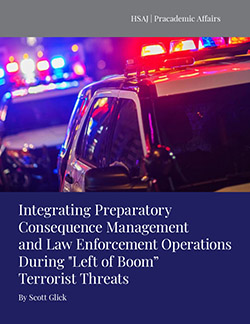
Integrating Preparatory Consequence Management and Law Enforcement Operations During “Left of Boom” Terrorist Threats

Integrating Preparatory Consequence Management and Law Enforcement Operations During “Left of Boom” Terrorist Threats

Author: Scott Glick

Abstract

National policy now treats consequence management and law enforcement operations as a single integrated function. However, responding to an imminent terrorist threat, particularly one involving a weapon of mass destruction, is more complex than responding to an impending natural disaster. If the government conducts highly visible preparatory consequence management operations, a terrorist could be alerted, which could potentially jeopardize the government’s efforts to stop the terrorist. This article offers a new planning approach enabling all levels of government to integrate cohesively their operations to maximize their ability to stop the terrorist while minimizing the potential consequences if those efforts are unsuccessful.

This article was originally published at https://www.hsaj.org/articles/21159

Integrating Preparatory Consequence Management and Law Enforcement Operations During “Left of Boom” Terrorist Threats

Suggested Citation

Glick, Scott. “Integrating Preparatory Consequence Management and Law Enforcement Operations During “Left of Boom” Terrorist Threats,” Homeland Security Affairs: Pracademic Affairs 2, Article 3, (July 2022). www.hsaj.org/articles/21159. 

Introduction

“Mother Nature” does not care if the nation is prepared for a hurricane. However, if the government is aware of a terrorist threat, but the public is not aware of that threat, and the government conducts highly visible preparatory consequence management operations, then an alerted terrorist could change tactics or attack a different target. To avoid this potential “no-win” scenario, response and prevention mission planners across all levels of government must consider the unique and complicating factors that can adversely affect their mission’s success during credible terrorist threats, particularly those involving a weapon of mass destruction (WMD). This article builds on my previous writing in “Preparatory Consequence Management & Weapons of Mass Destruction”[1] and proposes a new way to bridge a planning gap that currently exists in national planning guidance. If federal, state, local, tribal and territorial (FSLTT) officials adopt this new approach and cohesively integrate preparatory consequence management operations and law enforcement operations across all levels of government for “left of boom” terrorist threats, they will maximize their ability to stop the terrorist while minimizing the potential consequences of the terrorist’s actions.

Background

To ensure the government’s natural disaster response is not “late to need,”[2] dedicated specialists can use analytical tools to issue guidance[3] that can lead to a range of preparatory consequence management actions taken in the days and hours leading up to the event. Consequence management planners design their operations to maximize the government’s ability to protect public health and safety, restore government services, meet basic human needs, and provide emergency relief to those affected by an incident.[4] These operations, which are part of the federal government’s response mission, are led by the U.S. Department of Homeland Security (DHS), acting through the Federal Emergency Management Agency (FEMA).[5]

By way of contrast, the federal government’s prevention mission operations – which include law enforcement and/or counterterrorism operations and are sometimes referred to as “crisis management”[6] operations – are led by the U.S. Department of Justice (DOJ), acting through the Federal Bureau of Investigation (FBI). The prevention mission’s focus is different. The primary focus is to avoid, prevent or stop a threatened or actual act of terrorism.[7] However, while “Mother Nature” does not care if the public is warned and prepared before an impending natural disaster, profoundly different considerations are present when the government is confronted with a terrorist threat and the public is not aware of that threat. Unlike nature’s indifference to preparations and warnings, if the government conducts highly visible preparatory consequence management operations, it could alert the terrorist and therefore adversely affect the success of the prevention mission.[8]

The National Response Framework (NRF)[9] and the Response Federal Interagency Operational Plan guide response and prevention planners and direct them to integrate and synchronize their operations. These planning documents emphasize establishing “joint priorities, particularly in areas such as incident site/crime scene access, pre-positioning, operations to resolve threats, public information and warning, and fatalities management.”[10] Since the response mission focuses on saving lives as well as protecting property, critical infrastructure, and/or the environment after an incident,[11] how to achieve unity of effort with the prevention mission before a terrorist incident is not addressed in the NRF or the response FIOP. Indeed, while the goal is to “simultaneously save lives, investigate and resolve threats, and/or prevent follow-on attacks,”[12] these planning documents do not provide specific planning guidance.

The National Prevention Framework (NPF) defines imminent terrorist threats to be when “intelligence or operational information warns of a credible, specific, and impending terrorist threat … that is sufficiently specific and credible to recommend implementation of additional measures to thwart the attack.”[13] It then notes that an imminent terrorist threat may “emerge at any time and become known through one of several different vectors: the U.S. intelligence community, federal, state or local law enforcement, or the American public.”[14] Understanding this point raises the following important question: what if the knowledge of an impending terrorist attack is only within the government? Moreover, how should the federal government and/or its SLTT partners respond to a “left of boom” WMD terrorist threat when the public is unaware of the threat? Terrorists may “select soft targets or other vulnerable environments to maximize casualties.”[15] Because of this, forward-leaning response planners must consider that highly visible response operations may cause terrorists to “strike quickly and move to another location before law enforcement can interdict and disrupt.”[16]

FSLTT officials need a new way to integrate cohesively preparatory consequence management operations and law enforcement operations during “left of boom” terrorist threats when the public is not aware of the threat, particularly those that involve a WMD. This article proposes that response and prevention planners across all levels of government use the new approach discussed below to develop comprehensive and integrated plans that will enable them to maximize their ability to stop the terrorist, while simultaneously minimizing the potential loss of life, damage to property, critical infrastructure, and the environment.

A New Approach

There are three key elements to developing a plan that will cohesively integrate prevention and response mission operations when the public is not aware of a WMD terrorist threat: dividing response options into operational phases, using an OPSEC (operational security) construct to analyze activities during those phases, and attention to critical considerations.

Operational Phases

When the response mission leans forward for impending natural disasters, the instinct is to “go big, go early.”[17] However, if a goal is not to alert the terrorist, this approach presents a potential conflict. In the same way that public disclosure of a spy’s activities could cause the spy’s cover to be “blown,” the more significant the public visibility of the preparatory consequence management operations, the greater the likelihood of alerting threat actors and adversely affecting the success of the prevention mission. Yet, without a robust ability to lean forward, particularly for threats involving a WMD,[18] the response mission’s ability to succeed may be adversely affected.

Under President G.W. Bush’s direction, Homeland Security Presidential Directive 5, Management of Domestic Incidents (2003), developed the National Incident Management System (NIMS) and emphasized the importance that all levels of government use shared structures, systems, processes, and vocabulary to guide response personnel.[19] NIMS defines a “staging area” as a “temporary location for available resources in which personnel, supplies, and equipment await operational assignment.”[20] If we were to think about “staging” as one part of an operation and then were to think about the other phases, the following four operational phases emerge:

  • Alert/Activation, in which personnel get notice;
  • Staging, in which personnel and equipment are assembled and loaded in preparation for deployment;
  • Deployment, in which  personnel and/or equipment are moved to or pre-positioned near a potential or actual incident site; and
  • Employment, in which personnel and equipment are operationally used in activities in response to threats or incidents.

Operational Security

Although we divided response operations into four phases, we still need to address the instinct to “go big, go early.” Here we can look to the concept of OPSEC  which the U.S. government has long considered as a critical planning construct for sensitive operations. OPSEC involves the “implementation of procedures and activities to protect sensitive or classified operations.”[21] By following OPSEC principles, the FSLTT government officials can deny a potential adversary information about the government’s intentions. Thus, if we were to view each of the four operational phases listed above through an OPSEC construct, we can think about the public visibility of each phase of each potential preparatory consequence management action and assess how likely that phase of that action would be to alert the terrorist.

Critical Considerations

The success of the response mission is critically important. In this regard, the response FIOP notes the importance of looking at “interdependencies.”[22] An interdependency exists when the execution of one part of an operation depends upon another part being executed. Stated another way, the failure of one part of a response operation could very well affect the success of the entire response operation. Interdependencies, however, can be “pooled, sequential or reciprocal.”[23] For example, let’s assume that medical countermeasures are needed to save lives. However, this effort’s success depends on delivering and administering medical countermeasures by personnel to the affected population.[24] Thus, interdependencies that could affect the success of the response mission’s operations must be considered.

In addition to understanding interdependencies, other considerations, such as time must also be taken into account. For example, the time needed to go from the alert and activation phase to the deployment and employment phase is a critical consideration for response planners, as illustrated by this example noted by the Centers for Disease Control and Prevention (CDC). If someone has symptoms of anthrax infection, the CDC notes that it is critical to get them medical care “as quickly as possible.”[25] Indeed, the CDC points out that certain antibiotics can “prevent anthrax from developing in people who have been exposed but have not developed symptoms.”[26] Thus, as the response FIOP emphasizes, prevention and response  decision-makers “must be in communication during times of an imminent threat so that response assets, to the extent practical and appropriate, may be pre-positioned.”[27] However, while pre-positioning medical countermeasures is a necessary first step, these planners also need to factor in the time it will take to distribute and administer those medical countermeasures to the population.

Planners must also consider the cumulative effect that preparatory consequence management actions could have on the overall public visibility of the response  operations. For example, a few consequence management actions may be unlikely to alert a threat actor when viewed in isolation.  However, if numerous such actions all were to happen in the same place at the same time, their cumulative effect could very well alert a threat actor.

Another critical consideration is the dynamic nature of some terrorist threat scenarios. Concerns about potentially compromising prevention operations could change as the facts and circumstances evolve, including if the public becomes more aware of the threat. As the federal government has emphasized, “suspected or actual involvement of terrorists adds a complicating dimension to incident management.”[28] Thus, whereas a public warning may be inadvisable at a certain point in time, evolving circumstances, including media disclosures, may indicate that such warnings or other publicly visible actions may be advisable.[29]

The Path to Development of a Plan

Guidance from the DHS’s Planning Considerations: Complex Coordinated Terrorist Attacks (CTTA) states that terrorists may select “soft targets or other vulnerable environments to maximize casualties,” and may move to a new target “before law enforcement can interdict and disrupt.”[30] As the CCTA guidance notes, one of the “major challenges” of responding to terrorist attacks is the integration of “crisis management (e.g., law enforcement, interdiction), consequence management (e.g., emergency management), and investigatory functions (e.g., evidence gathering, forensics, attribution). All must be performed simultaneously and involve entities that may not habitually operate together.”[31]

The CCTA guidance, like the NRF and the response FIOP, focuses on “right of boom.” Nonetheless, and building on FEMA’s multi-step planning process,[32] which is already well known to FSLTT planners, the CCTA guidance provides a roadmap for them to develop a plan to address “left of boom” terrorist threats when the public is not aware of the terrorist threat. The following steps are therefore recommended for response planners to ensure the development of a comprehensive plan that will lead to risk-informed decisions.

  • Assemble a planning team of relevant stakeholders from the response and prevention mission communities (e.g., law enforcement, counterterrorism, first responders, public health officials, private sector).
  • Ensure a common understanding of all the complexities, interdependencies, and other factors and the need for cohesive, integrated planning and operations.
  • Identify each potential preparatory consequence management action that can be taken.
  • Break down each potential preparatory consequence management action into one of the following major phases: alert/activation, staging, deployment, and employment for resources and personnel.
  • Agree on a default public visibility rating in each phase for each potential preparatory action. Using common terminology, assess whether the action is unlikely, likely, or highly likely to alert a threat actor.[33]
  • Develop an integrated and cohesive plan that considers all appropriate factors, including but not limited to the nature of the threat and the threat actor, interdependencies that exist, the effect that cumulative preparatory consequence management actions can have on the overall public visibility of the Response Mission’s operations, and the fact that circumstances can evolve; and
  • After developing the plan, exercise it regularly and revise it as part of a continuous improvement cycle, including based on lessons learned from exercises and responses to real-world events.

Planning Across All Levels of Government

The seven planning steps discussed above need to involve all levels of government to maximize the chances for the success for both prevention and response missions, particularly for terrorist threats involving chemical, biological, radiological, and nuclear (CBRN) materials, weapons, and/or dispersal devices. For example, the federal government has a new interagency coordination mechanism for coordinating the federal government’s response to WMD terrorist threats, namely, the Weapons of Mass Destruction Strategy Group (WMDSG).[34] The WMDSG is an FBI-led interagency crisis action team supporting information exchange and the deconfliction of consequence management and law enforcement operations.[35] The federal government co-locates the Consequence Management Coordination Unit (staffed and managed by FEMA) directly in the WMDSG. This allows “real-time” information sharing, strategic advice, and recommended consequence management courses of action that can take into account ongoing law enforcement and counterterrorism operations.[36] SLTT governments should mirror this approach and co-locate and integrate law enforcement and consequence management operations.

Indeed, as the federal government has pointed out, it cannot combat WMD terrorism alone. As a result, the federal government’s response to a terrorist threat may need to be augmented by assets and resources under the control of SLTT governments.[37] These may be tasked with locating the terrorist and the weapon the terrorist intends to use to carry out the attack or to assist in mitigating the potential consequences of the threat. For example, let us assume a terrorist threatens to use a WMD. The National Guard has 57 WMD-civil support teams across the country. These civil support teams can “identify chemical, biological, radiological and nuclear agents and substances, assess current and projected consequences, advise on response measures, and assist with requests for additional support.”[38]

Similarly, SLTT public health resources may be needed to augment the distribution and administration of medical countermeasures or to otherwise prepare for mass casualty events, as illustrated by the federal government’s delivery of Covid-19 vaccines to “loading docks” that needed states and localities to “take over from there.”[39] An act of terrorism involving CBRN materials that may “overwhelm the capabilities of many local, state and/or tribal governments to respond” may also “seriously challenge existing Federal response capabilities.”[40] As a result, unity of effort will be required, which mandates the seamless integration of law enforcement and consequence management operations. In the same way that unity of effort was improved through the adoption of NIMS, the federal government and its SLTT partners should adopt the new approach discussed above to develop a cohesive plan for integrating preparatory consequence management and law enforcement operations during “left of boom” terrorist threats when the public is not aware of the threat, particularly for those involving the threatened use of a WMD.

Finally, while some preparatory consequence management actions can alert a terrorist and adversely affect the prevention  operations, response planners may nonetheless recommend those actions to decision-makers to minimize the potential negative effect on the mission. While these recommendations may raise difficult discussions and require difficult decisions, senior government officials must also consider the success of the response.

Conclusion

Since 2003, national policy has treated law enforcement crisis management operations and consequence management as a single integrated function.[41] However, responding to terrorist threats can be more complicated than responding to natural disasters. Moreover, when a terrorist is threatening the use of a WMD, effective response can be even more complex because of the unique challenges that exist in responding to threats involving CBRN materials, dispersal devices, and weapons.[42] If the public is not aware of the terrorist threat and the government conducts highly visible preparatory consequence management operations, the terrorist could be alerted, potentially jeopardizing the success of the prevention mission’s efforts. At the same time, it is essential to consider interdependencies and other factors that can affect the success of the response mission’s efforts.

All levels of government must adopt a unified approach that cohesively integrates preparatory consequence management and law enforcement operations during “left of boom” terrorist threats. The successful resolution of imminent terrorist threats will require more than cohesive and integrated planning and operations. Senior government officials may need to make tough decisions involving competing risk and value trade-offs. To best support them, the federal government’s and SLTT government’s approach to “left of boom” terrorist threats and the coordination mechanisms should be similar and integrate seamlessly. This will ensure that decision-makers across all levels of government have the same understanding of the threat and that course of action options are developed with the risk-informed input from stakeholders in all mission areas.


About the Author

Scott J. Glick is vice president and general counsel for Summit Exercises and Training LLC (SummitET®), a veteran-owned small business that specializes in providing proven preparedness solutions to systematically address all threats and hazards through a wide range of services, including planning, training, and exercises, as well as operational and policy support, for its government and private sector clients. He has four decades of experience in law enforcement, counterterrorism, critical incident response, exercises, and emergency preparedness. He previously served as the director of preparedness and response and senior counsel in the National Security Division at the U.S. Department of Justice (DOJ), where he led DOJ’s national preparedness policy and planning efforts, including in regard to countering weapons of mass destruction. He has investigated and prosecuted international terrorism cases as a federal prosecutor, and organized crime cases as a state prosecutor in New York. Since his retirement from DOJ, he has provided substantial advice and guidance to numerous federal departments and agencies on the cohesive integration of law enforcement, counterterrorism, and consequence management operations in response to terrorist threats. This article contains no classified or confidential government or business information, and the views expressed in this article are solely those of the author and do not necessarily represent the views of any government department or agency, or any private sector company.


 

Scott Glick VP and General Counsel

Scott Glick

Vice President & General Counsel

Notes

[1] Scott J. Glick, Preparatory Consequence Management & Weapons of Mass Destruction, DomPrep Journal (November 2020), https://www.domesticpreparedness.com/preparedness/preparatory-consequence-management-weapons-of-mass-destruction/.

[2] Karen Roganov, FEMA, State, Military, Guard, CAP, Volunteers, Rehearse Whole-of-Government Crisis Response, Joint Task Force Civil Support News (June 18, 2019), https://www.jtfcs.northcom.mil/MEDIA/NEWS-ARTICLES/Article/1879772/fema-state-military-guard-cap-volunteers-rehearse-whole-of-government-crisis-re/.

[3] E.g., “Severe T-Storms Prompt Tornado Watch in Parts of Tri-State Area,” WCBS NewsRadio 880 (August 27, 2020), https://www.audacy.com/wcbs880/articles/news/cuomo-ny-agencies-to-pre-deploy-emergency-response-assets.

[4] FEMA Mission Areas and Core Capabilities, (Last updated July 20, 2020), https://www.fema.gov/emergency-managers/national-preparedness/mission-core-capabilities.

[5] PDD-62, Protection Against Unconventional Threats to the Homeland and Americans Overseas, at 5-6 (May 22, 1998) (“When the Attorney General, acting on the advice of the Director, FBI, and in coordination with the Director, FEMA, determines that the incident or threat of an incident has subsided, lead agency responsibility may be transferred to FEMA.”), https://clinton.presidentiallibraries.us/items/show/16200.

[6] Presidential Decision Directive (PDD) 39, U.S. Counterterrorism Policy, 6, (June 21, 1995), (“Within the United States, the Department of Justice, acting through the FBI, shall have lead responsibility for management of terrorist incidents,”   https://clinton.presidentiallibraries.us/items/show/12755.

[7] National Prevention Framework, 1, (2d Ed. 2016), https://www.fema.gov/sites/default/files/2020-04/National_Prevention_Framework2nd-june2016.pdf.

[8] Scott J. Glick, Preparatory Consequence Management & Weapons of Mass Destruction, DomPrep Journal (November 2020), https://www.domesticpreparedness.com/preparedness/preparatory-consequence-management-weapons-of-mass-destruction/.

[9] National Response Framework, 2, (4th Ed. 2019), https://www.fema.gov/sites/default/files/2020-04/NRF_FINALApproved_2011028.pdf.

[10] Response FIOP, 5, (2d Ed. 2016), https://www.fema.gov/sites/default/files/documents/fema_response-fiop.pdf .

[11] National Response Framework, 12, (4th Ed. 2019), https://www.fema.gov/sites/default/files/2020-04/NRF_FINALApproved_2011028.pdf.

[12] Ibid.

[13] National Prevention Framework, 3, (2d Ed. June 2016), https://www.fema.gov/sites/default/files/2020-04/National_Prevention_Framework2nd-june2016.pdf.

[14] Ibid., 3.

[15] DHS, Planning Considerations: Complex Coordinated Terrorist Attacks, 2, (July 2018), https://www.fema.gov/sites/default/files/2020-07/planning-considerations-complex-coordinated-terrorist-attacks.pdf.

[16] Ibid.; See also U.S. Department of State, International Travel, Terrorism (Listing recommendations for travelers to “avoid becoming a target of opportunity”), https://travel.state.gov/content/travel/en/international-travel/emergencies/terrorism.html.

[17] FEMA, Leaning Forward: Go Big, Go Early, Go Fast, Go Smart, https://www.fema.gov/pdf/about/state_of_fema/state_of_fema.pdf.

[18] Podcast: Spotlight on FEMA’s CBRN Office (November 29, 2019), https://cbrnecentral.com/the-fema-podcast-spotlight-on-femas-cbrn-office/21038/ (FEMA official noting “We’re always trying to lean forward in the CBRN realm as well.”).

[19] National Incident Management System (Third Ed. 2017), https://www.fema.gov/sites/default/files/2020-07/fema_nims_doctrine-2017.pdf. For a historical chronology of FEMA and the management of the consequences of terrorism from 1972 through 2009, see Baldwin, “FEMA’s Terrorism Consequences Role as Assigned by Section 2-103 of E.O. 12148,” https://fas.org/irp/agency/dhs/fema/chron.pdf.

[20] National Incident Management System, Glossary, 70, (3rd Ed. 2017), https://www.fema.gov/sites/default/files/2020-07/fema_nims_doctrine-2017.pdf.

[21] National Incident Management System, Glossary, 68, (3rd Ed. 2017), https://www.fema.gov/sites/default/files/2020-07/fema_nims_doctrine-2017.pdf.

[22] Ibid., 4.

[23] Profit Management Solutions, “How Are You Managing Your Team Interdependence,” (August 3, 2020), https://proffittmanagement.com/how-are-you-managing-your-team-interdependence/.

[24] Richard Sisk, “Shots in Arms Within 24 Hours: Army General’s Complex Vaccine Delivery Task Takes Shape,” Military News (October 26, 2020), https://www.military.com/daily-news/2020/10/26/shots-arms-within-24-hours-army-generals-complex-vaccine-delivery-task-takes-shape.html (large scale distribution of vaccines is complex from a “logistical standpoint).

[25] Centers for Disease Control and Prevention, Treatment of Anthrax Infection (Last reviewed November 20, 2020), https://www.cdc.gov/anthrax/treatment/index.html.

[26] Centers for Disease Control and Prevention, Antibiotics to Prevent Anthrax After Exposure, (Last reviewed November 20, 2020), https://www.cdc.gov/anthrax/prevention/antibiotics/index.html.

[27] Ibid., 5.

[28] FEMA, Terrorism Incident Law Enforcement and Investigation Annex, 3, (December 2004), https://www.fema.gov/sites/default/files/2020-07/fema_incident-annex_terrorism-law-enforcement.pdf.

[29] Connor Simpson, “F.B.I. Released the Tsarnavev’s Photos Because of Reddit and the Post,” The Atlantic (April 21, 2013), https://www.theatlantic.com/national/archive/2013/04/fbi-released-tsarnaev-brothers-photos-because-reddit-and-post/316075/.

[30] DHS, Planning Considerations: Complex Coordinated Terrorist Attacks, 2, (July 2018), https://www.fema.gov/sites/default/files/2020-07/planning-considerations-complex-coordinated-terrorist-attacks.pdf.

[31] Ibid.,3.

[32] FEMA, Developing and Maintaining Emergency Operations Plans: Comprehensive Preparedness Guide (CPG) 101, 43, (Ver. 3 2021), https://www.fema.gov/sites/default/files/documents/fema_cpg-101-v3-developing-maintaining-eops.pdf.

[33] Intelligence Community Directive (ICD) 203 (January 2, 2015) highlights the importance of expressing likelihood or using the same terminology (i.e., not mixing words with percentages). By thinking about each phase of each potential preparatory consequence management action and placing that action in a default category of its likelihood to alert the threat actor, Response and Prevention Mission planners can collectively, using the same terminology, effectively understand the degree to which each potential action could adversely affect the success of the Prevention Mission.

[34] U.S. Department of Homeland Security, Protection Federal Interagency Operational Plan (FIOP), First Edition, C-3-12, (January 2016), https://www.fema.gov/sites/default/files/documents/fema_protection-fiop.pdf; See also U.S. Department of Homeland Security, FIOP Response and Recovery, Oil/Chemical Incident Annex, 4-8, (June 2016), https://www.fema.gov/sites/default/files/2020-07/fema_incident-annex_oil-chemical.pdf.

[35] Ibid.

[36] FEMA, Protection Federal Interagency Operational Plan, Appendix C to Annex C, C.3-12, (1st ed. January 2016), https://www.fema.gov/sites/default/files/documents/fema_protection-fiop.pdf.

[37] National Strategy for Countering Weapons of Mass Destruction Terrorism, 11, (December 1, 2018), https://www.hsdl.org/?view&did=819382 (WMD terrorism cannot be “combatted exclusively by Federal authorities” and many others, including first responders, and health care professionals play a key role in protecting the nation against WMD threats).

[38] National Guard, Weapons of Mass Destruction (WMD) Civil Support Team (CST) (Current as of December 2017), https://www.nationalguard.mil/Portals/31/Resources/Fact%20Sheets/Weapons%20of%20Mass%20Destruction%20Civil%20Support%20Team%20Fact%20Sheet%20(Dec.%202017).pdf .

[39] Karen Weintraub and Elizabeth Weise, Analysis: What Went Wrong with COVID-19 Vaccine Distribution and How It Has Tarnished The ‘Miracle,’” USA Today (January 31, 2021), https://www.usatoday.com/story/news/health/2021/01/31/covid-vaccine-what-went-wrong-distribution-whats-being-changed/4275954001/.

[40] FEMA, Terrorism Incident Law Enforcement and Investigation Annex, 3, (December 2004), https://www.fema.gov/sites/default/files/2020-07/fema_incident-annex_terrorism-law-enforcement.pdf.

[41] Homeland Security Presidential Directive 5, para. 3, Management of Domestic Incidents (February 23, 2003).

[42] FEMA, Federal Interagency Operational Plans, (Last updated April 30, 2021), https://www.fema.gov/emergency-managers/national-preparedness/frameworks/federal-interagency-operational-plans.

Copyright

Copyright © 2022 by the author(s).

Bridging the Gap IAEM Series Episode 14 with Emergency Management Students

Bridging the Gap IAEM Series – Episode 14: The Student Perspective on Emergency Management

In this special IAEM Conference Series episode of Bridging the Gap, SummitET podcast host and former emergency manager Ron Crane meets with Massachusetts Maritime Academy students about their experiences studying and interning in Emergency Management and their perceptions regarding challenges in the field.

SummitET Bridging the Gap Podcast IAEM Series Kenn Honig

Bridging the Gap IAEM Series – Episode 13: Emergency Management Insights from Kenn Honig

In this special IAEM Conference Series episode of Bridging the Gap, SummitET host Adam Montella is joined by Kenn Honig, a seasoned emergency management consultant with a long career in law enforcement and emergency management at the Port Authority of New York and New Jersey. Join this insightful discussion as they navigate the evolution of emergency management practices, the technological advancements over the decades, and the undeniable importance of personal contacts in the field.

SummitET Bridging the Gap podcast IAEM series Episode 12 DC Metro Emergency Management

Bridging the Gap IAEM Series – Episode 12: D.C. Metro Area Emergency Management

In this special IAEM Conference Series episode of Bridging the Gap, Shannon McCrone, TT&E Program Manager with the U.S. House Sergeant at Arms and Ron Benedict, Readiness, Response and Resiliency Program Manager with DC Department of Health share their experiences, challenges, and ideas for improvement in emergency management in the DC metro area.

Bridging the Gap IAEM Series Podcast Episode 11 Preston Wilson and Dam Safety

Bridging the Gap IAEM Series – Episode 11: Preston Wilson and Dam Safety

In this special IAEM Conference Series episode of Bridging the Gap, host Ron Crane with SummitET is joined by Preston Wilson, CEO of Resilience Solutions Consulting. Prior to this role, Preston was the training manager for FEMA’s National Dam Safety Program, where he was responsible for developing and delivering training on emergency management and dam safety nationwide.