Adam Montella Appointed as New President of ACP Mid-Florida Chapter

Adam Montella Appointed as New President of ACP Mid-Florida Chapter

Leadership Transition Marks New Era for Renowned Business Continuity Organization

The Mid-Florida Chapter of the Association of Contingency Planners (ACP) is pleased to announce the appointment of Adam Montella as its new Chapter President. Adam, who also serves as Chief Operations Officer at SummitET, steps into the role following the tenure of Eric Olson, who led the chapter for over two decades, guiding its growth and strengthening its reputation within the business continuity and disaster recovery community.

Founded in January 1993 and officially recognized by the Association of Contingency Planners in February of the same year, the ACP Mid-Florida Chapter has served as a cornerstone for professionals seeking to enhance their organization’s resiliency and contingency strategies. The chapter proudly serves members across a broad region, reaching as far west as Tampa and as far south as Miami, reflecting its commitment to supporting professionals throughout Central and South Florida.

The chapter regularly hosts monthly meetings, fostering a collaborative environment where industry experts and newcomers alike can exchange ideas and best practices. The first meeting is complimentary for guests, with ongoing membership required for continued participation in events and networking opportunities.

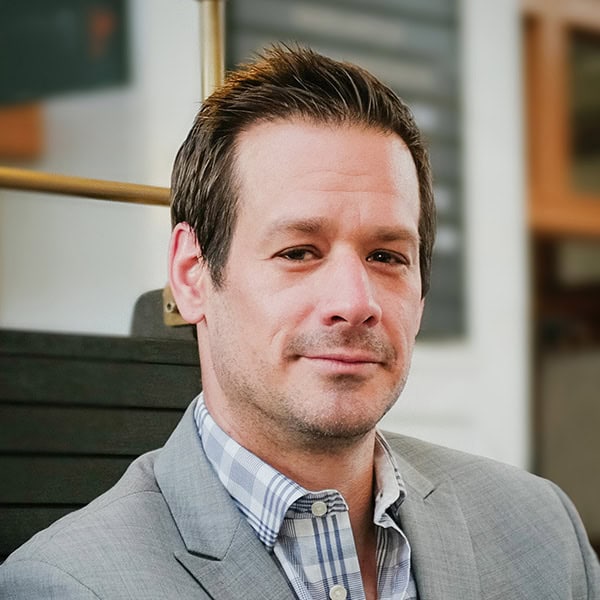
Adam Montella headshot

“I am honored to follow in the footsteps of Eric Olson, whose leadership has been instrumental in building this supportive community,” said Adam Montella. “I look forward to working with our members to continue advancing the field of business continuity and disaster recovery throughout the Mid-Florida region.”

Professionals interested in learning more about the ACP Mid-Florida Chapter or attending an upcoming meeting are encouraged to visit https://acp-international.com/midflorida for additional information.

SummitET News

Montgomery County Office of Public Health

Montgomery County Office of Public Health

Background

Montgomery County, Pennsylvania, is committed to safeguarding its residents through robust emergency management and public health strategies. Recognizing the growing complexity of emergencies—from natural disasters to public health crises—the Montgomery County Office of Public Health (OPH) and Department of Public Safety (DPS) sought to ensure their plans and operations were fully aligned and capable of addressing diverse threats. To achieve this, they partnered with SummitET, a leader in emergency preparedness and response, to enhance coordination, clarify roles, and strengthen operational alignment across public health and emergency management functions.

Mission Need

The central mission was to bridge gaps between OPH and DPS, ensuring both agencies could respond swiftly and effectively to emergencies. There was a critical need for comprehensive, integrated plans, clear role definitions, and training resources that would empower personnel to act decisively. The goal was to create unified strategies, tools, and exercises that would enable Montgomery County to protect its community under any circumstance.

Solution

SummitET delivered a multi-faceted initiative designed to transform Montgomery County’s emergency management and public health preparedness:

  • Comparative Plan Review: Conducted a detailed comparison between the OPH Incident Response Plan and the DPS Emergency Operations Plan to ensure seamless operational alignment and integration between public health and emergency management functions.
  • Gap Analysis & Stakeholder Engagement: Assessed existing plans against federal and state standards, while hosting virtual town halls to gather real-world insights and foster active stakeholder involvement.
  • Actionable Tools: Developed an Emergency Response Matrix that clearly defines agency roles, responsibilities, and unified command structures. Additionally, rapid-response “break-glass” playbooks were created for five high-risk incident and accident scenarios, enabling immediate, coordinated activation of relevant agencies for timely and effective response.
  • Training Roadmaps: Produced in-depth, role-specific onboarding guides for OPH and DPS personnel to accelerate readiness and ensure consistent emergency response capabilities across agencies.
  • Interactive Exercise: Facilitated an in-person, scenario-based workshop featuring six realistic scenarios to test and validate cross-agency collaboration and the newly developed emergency response matrix.

Result

Through this comprehensive partnership, Montgomery County now benefits from stronger, more integrated emergency response plans and tools. The collaborative efforts led to enhanced coordination between OPH and DPS, clarified roles and responsibilities, and streamlined operational alignment. Personnel are equipped with practical, actionable resources and training, improving their readiness for real-world incidents. The interactive workshop validated these improvements, ensuring agencies can work together seamlessly during emergencies.

Conclusion

“By strengthening emergency preparedness collaboration across departments, we’re building more resilient communities and ensuring every resident benefits from a stronger, more connected system,” said Christina Miller, Administrator, Montgomery County Department of Health and Human Services Office of Public Health.

SummitET’s partnership with Montgomery County OPH and DPS marks a significant advancement in public health and emergency management preparedness. Through detailed plan reviews, stakeholder engagement, actionable tools, targeted training, and realistic exercises, the county is now better positioned to protect its community during emergencies. This success story demonstrates the value of collaboration, innovation, and strategic planning in building resilient communities.

Read the Press Release. 


State of California, Office of Emergency Services

State of California, Office of Emergency Services

Background

The California WMD Summit was established to enhance the state’s readiness for Weapons of Mass Destruction (WMD) incidents through the Office of Emergency Services. This annual event aims to bring together key agencies and organizations to strengthen collaboration and improve multi-jurisdictional response capabilities.

Mission

The summit’s mission is to provide comprehensive WMD response training for the State of California and unite the four FBI offices through a complex, multi-city, multi-jurisdictional, all-hazard training exercise. By fostering interagency cooperation, the summit ensures that participants are well-prepared to address a range of potential threats and emergencies.

Solution

SummitET played a pivotal role in planning and executing the 2023 and 2024 WMD Summit. The team supported CalOES by developing and facilitating the Tabletop Exercise (TTX), coordinating closely with the FBI WMDD, and providing Observer/Controller and PIO/EOD SME support for the Full-Scale Exercise (FTX). This hands-on approach ensured that all participants received practical experience and expert guidance.

Result

The 2024 CalOES WMD Summit saw an impressive turnout, with 245 participants representing approximately 110 departments, agencies, organizations, and private companies.

SummitET has consistently supported the summit since 2022 and recently completed the 2025 event in Los Angeles, reflecting a strong ongoing partnership. The WMD Summit provides invaluable networking opportunities and fostered a deeper understanding among all stakeholders.

As one anonymous participant shared, “Overall, I thought this was an amazing exercise and experience. The networking and greater understanding of what others are doing to prepare for potential WMDs was invaluable!”

Conclusion

The California WMD Summit continues to set the standard for collaborative emergency preparedness. SummitET’s expertise and dedication have been integral to the event’s success, helping to ensure California’s agencies are equipped to respond effectively to WMD incidents. The sustained partnership and positive feedback demonstrate the lasting impact of this vital training initiative.

Bridging the Gap Episode 16: The Evolution and Capabilities of Previstar®: A Journey Through Time

Bridging the Gap Episode 16: The Evolution and Capabilities of Previstar®: A Journey Through Time

In this episode of “Bridging the Gap,” Adam Montella, COO, along with Mark Amann, CPO, and Himadri Banerjee, CTO, delve into the fascinating history and capabilities of Previstar®, a software that has played a pivotal role in emergency and incident management for over two decades.

A Journey Through Time

Adam Montella’s journey with Previstar began 20 years ago when he was one of the original customers of its precursor, RamSafe. Developed at Oak Ridge National Labs by Himadri Banerjee and his team, RamSafe was an innovative software that transformed a static spreadsheet predicting morbidity, mortality, and resource needs for chemical and biological weapons of mass destruction into a dynamic tool.

From RamSafe to Previstar

The software’s evolution continued as it was used in various real-world scenarios, including managing resources during the 2004 hurricane season in Florida and the response to Hurricane Katrina in New Orleans. These experiences helped shape Previstar into a comprehensive emergency management tool.

Capabilities of Previstar

Previstar is a whole lifecycle emergency and incident management software with various modules designed to aid in planning, response, and recovery. The software includes modules for planning, organizing around FEMA’s CPG 101, managing the tracking and deployment of resources, and handling costs associated with incidents. It also features an exercise module and a robust Geographic Information System (GIS) interface, making it accessible even for smaller jurisdictions without a GIS specialist.

Technological Advancements

Himadri highlights the technological advancements integrated into Previstar, including the use of AI and machine learning. These technologies enable the software to predict resource needs with high accuracy and assist in planning and response efforts. The integration of large language models like OpenAI and Meta’s Llama further enhances the software’s capabilities, making it a powerful tool for emergency management.

A Product Built by Practitioners for Practitioners

One of the unique aspects of Previstar is that it was built by emergency managers for emergency managers. Himadri’s firsthand experience in the field, combined with his expertise in technology, has resulted in a product that truly understands and meets the needs of its users.

Looking Ahead

With SummitET’s acquisition of Previstar, the software is set to continue its evolution and enhancement. The combination of Previstar’s dynamic technology and SummitET’s subject matter expertise promises to deliver even better solutions for emergency management in the future.

Previstar’s rich history and advanced capabilities make it a standout tool in the field of emergency management. Its journey from RamSafe to a comprehensive incident management tool is a testament to the dedication and expertise of its team. As technology continues to advance, Previstar is poised to remain at the forefront of emergency management solutions.

Meet the Experts Featured in This Podcast

Himadri Banerjee

Himadri Banerjee

Chief Technology Officer; Developer of Previstar CPS; Incident Management Tech SME

Adam Montella headshot

Adam Montella

Chief Operations Officer; Disaster Management SME

Mark Amann

Mark Amann

Chief Products Officer; Emergency Management SME

SummitET Bridging the Gap Podcast IAEM Series Kenn Honig

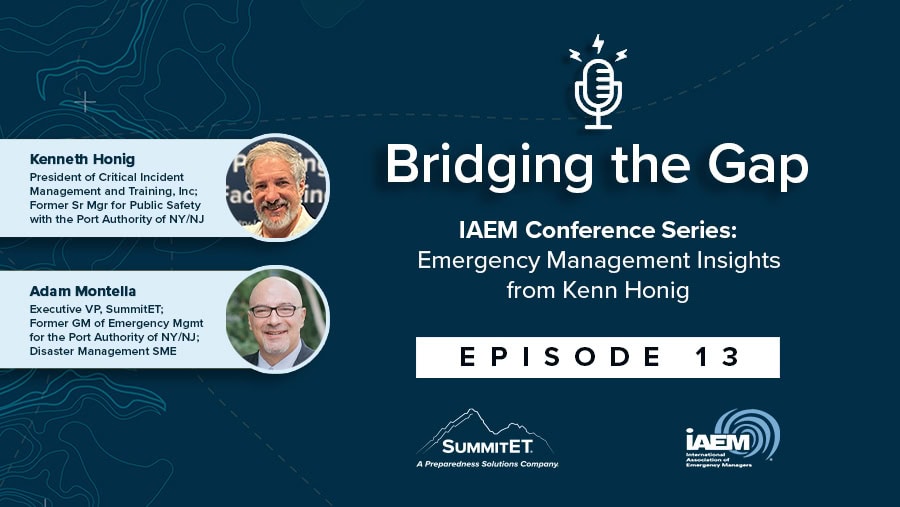
Bridging the Gap IAEM Series – Episode 13: Emergency Management Insights from Kenn Honig

In this special IAEM Conference Series episode of Bridging the Gap, SummitET host Adam Montella is joined by Kenn Honig, a seasoned emergency management consultant with a long career in law enforcement and emergency management at the Port Authority of New York and New Jersey. Join this insightful discussion as they navigate the evolution of emergency management practices, the technological advancements over the decades, and the undeniable importance of personal contacts in the field.

SummitET Bridging the Gap podcast IAEM series Episode 12 DC Metro Emergency Management

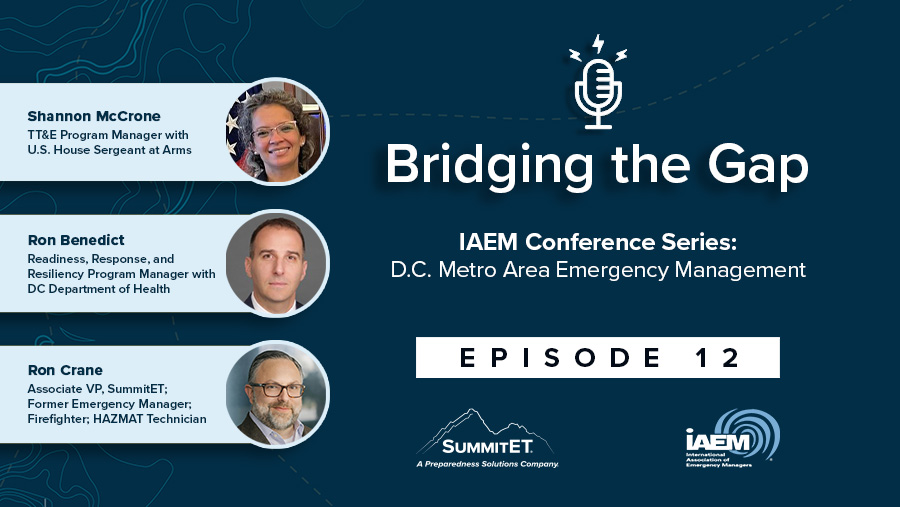
Bridging the Gap IAEM Series – Episode 12: D.C. Metro Area Emergency Management

In this special IAEM Conference Series episode of Bridging the Gap, Shannon McCrone, TT&E Program Manager with the U.S. House Sergeant at Arms and Ron Benedict, Readiness, Response and Resiliency Program Manager with DC Department of Health share their experiences, challenges, and ideas for improvement in emergency management in the DC metro area.

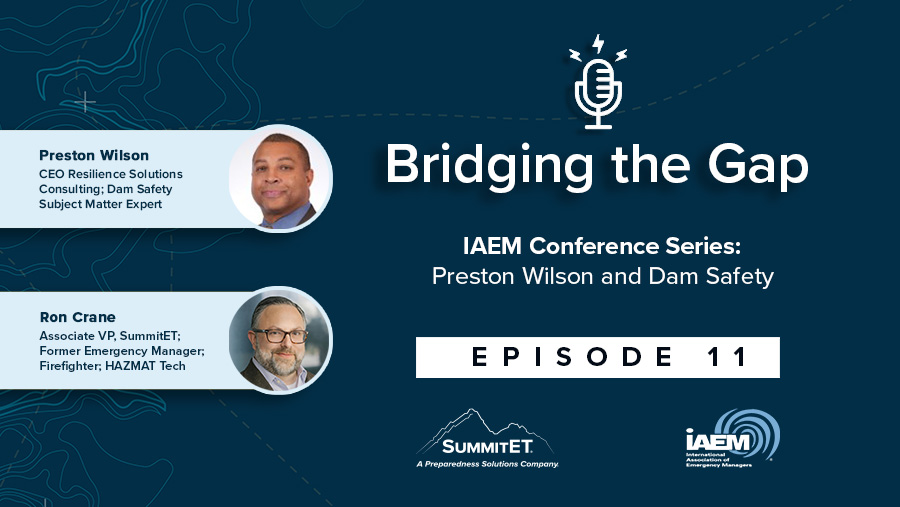
Bridging the Gap IAEM Series Podcast Episode 11 Preston Wilson and Dam Safety

Bridging the Gap IAEM Series – Episode 11: Preston Wilson and Dam Safety

In this special IAEM Conference Series episode of Bridging the Gap, host Ron Crane with SummitET is joined by Preston Wilson, CEO of Resilience Solutions Consulting. Prior to this role, Preston was the training manager for FEMA’s National Dam Safety Program, where he was responsible for developing and delivering training on emergency management and dam safety nationwide.

Bridging the Gap podcast, IAEM Series Episode 10: Kansas City Metro Area Emergency Management

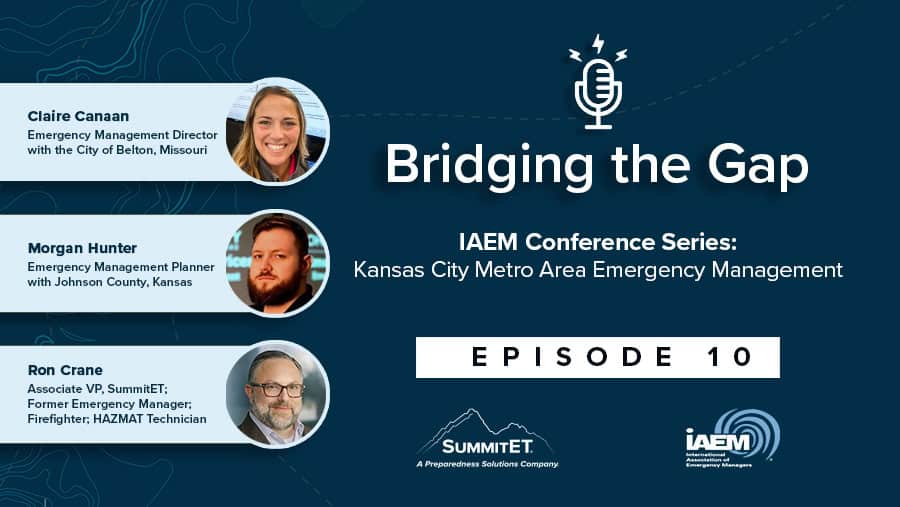
Bridging the Gap IAEM Series – Episode 10: Kansas City Metro Area Emergency Management

In this IAEM Conference Series podcast episode of Bridging the Gap, SummitET host Ron Crane sits down with Claire Canaan and Morgan Hunter, emergency managers from the Kansas City metropolitan area. They discuss challenges in the EM field including staffing shortages and communication barriers, and the importance of embracing change and innovation.

Bridging the Gap podcast graphic, IAEM Conference Series

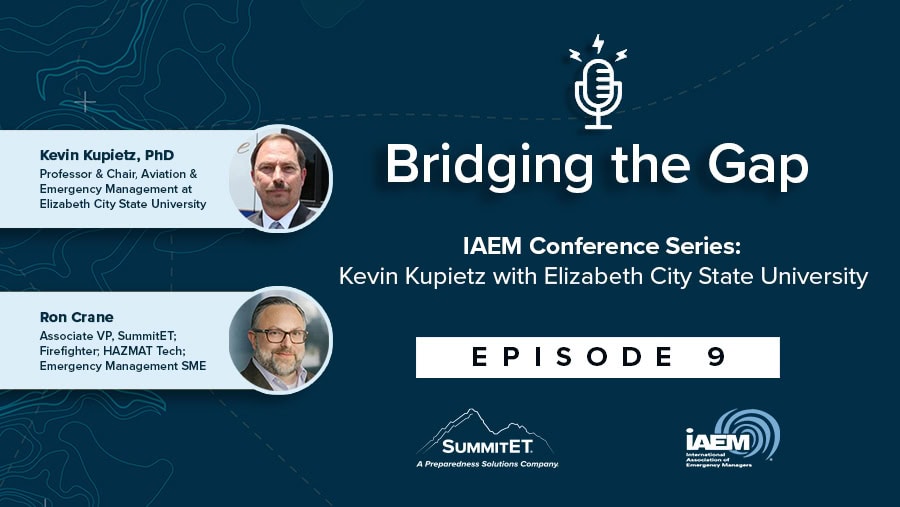
Bridging the Gap IAEM Series – Episode 9: Kevin Kupietz with Elizabeth City State University

In this IAEM Conference Series podcast episode of Bridging the Gap, SummitET host Ron Crane discusses current challenges and opportunities in Emergency Management education with Elizabeth City State University Professor Kevin Kupietz, PhD.

SummitET Bridging the Gap podcast graphic

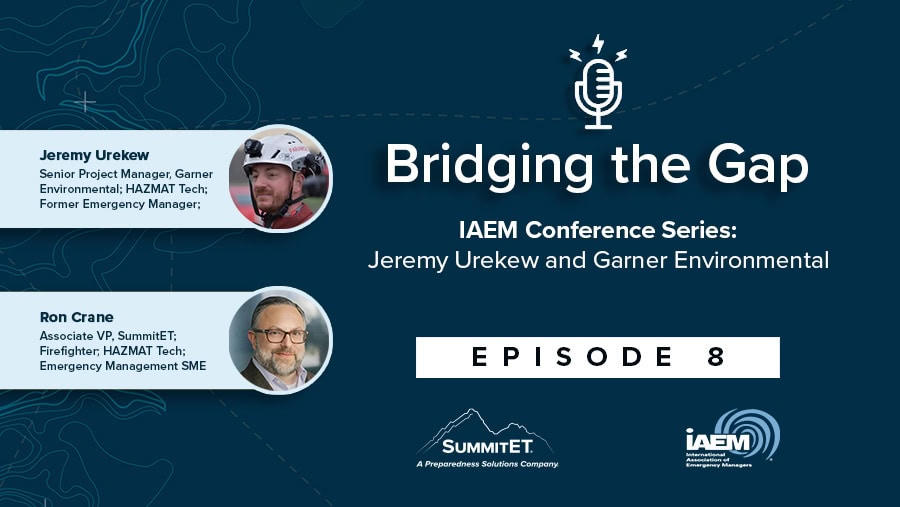
Bridging the Gap IAEM Series – Episode 8: Jeremy Urekew and Garner Environmental

In this IAEM Conference Series episode of SummitET’s podcast Bridging the Gap, Jeremy Urekew with Garner Environmental and Ron Crane of SummitET discuss ideas for improving challenges in the Emergency Management field. Jeremy has a background in emergency management, fire service, hazmat response, and counterterrorism work. With 25 years of experience in the public sector, he moved to the private sector by joining Garner Environmental Services, Inc., a disaster and emergency response company headquartered in Houston, TX.

Bridging the Gap preparedness podcast graphic

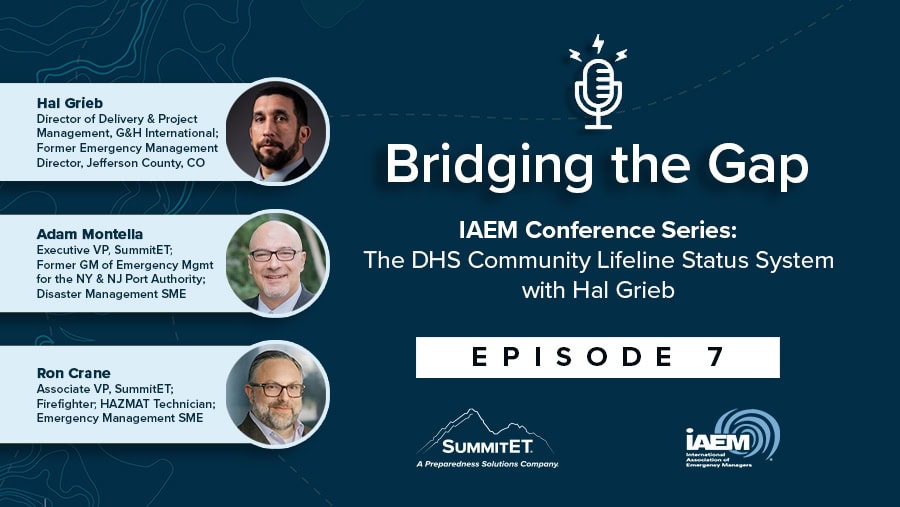
Bridging the Gap IAEM Series – Episode 7: The DHS Community Lifeline Status System with Hal Grieb

In this special IAEM Conference Series episode of Bridging the Gap, SummitET experts discuss the Community Lifeline Status System Project with Hal Grieb of G&H International Services. This software reporting tool is developed for the DHS to operationalize FEMA’s Community Lifelines construct and provides a data-driven framework to help emergency managers assess and report on critical services during disasters.

Bridging the Gap Episode 15: Japan and U.S. Experts Talk Disaster Management

Bridging the Gap Episode 15: Japan and U.S. Experts Talk Disaster Management

SummitET had the honor of hosting a distinguished delegation of disaster management experts from Japan. This visit, ahead of the National Hurricane Conference, provided a unique opportunity to exchange ideas and share experiences in disaster management and preparedness.

Shared Challenges and Lessons Learned

Conversation quickly revealed the many parallels between hurricane preparedness in Florida and Japan, particularly in coastal communities with large elderly populations and challenging evacuations. There is specific interest in understanding planning and response patterns during the recent hurricanes in Florida and the lessons that could be applied to Japan. This team emphasized the importance of storm surge awareness, noting that Japan has not experienced a significant storm surge disaster in over 70 years.

Looking Ahead

The delegation expressed interest in the concept of qualified crisis management officers stationed in welfare facilities and hospitals, a practice they hope to see implemented in Japan. They are committed to bridging the gap between their current practices and the structured approaches observed in the United States.

Conclusion

The visit from the Japanese experts was a valuable opportunity to share knowledge and strengthen international collaboration in disaster preparedness. As we continue to face global challenges, it is through these exchanges that we can learn, adapt, and improve our strategies to protect communities.

Meet the Experts Featured in This Podcast

Ichiro Matsuo

Ichiro Matsuo

Visiting Professor with the Center for Integrated Disaster Information Research (CIDIR) at University of Tokyo

Tomoo Inoue

Tomoo Inoue

Professor with the Disaster Prevention Research Institute (DPRI) at Kyoto University

Himeno Kazuki

Himeno Kazuki

Senior Researcher with the Coastal Research Institute at the Ministry of Land, Infrastructure, Transport, and Tourism (MLIT), Japan

Jiro Kakehashi

Jiro Kakehashi

Deputy Director for the River Planning with Water and Disaster Management at the Ministry of Land, Infrastructure, Transport, and Tourism (MLIT), Japan

Joel Challender

Joel Challender

Interpreter/ Researcher with the Crisis and Environment Management Policy Institute (CeMI)

Adam Montella headshot

Adam Montella

Executive VP, SummitET; Former GM of Emergency Mgmt for the Port Authority of NY/NJ; Disaster Management SME

SummitET Bridging the Gap Podcast IAEM Series Kenn Honig

Bridging the Gap IAEM Series – Episode 13: Emergency Management Insights from Kenn Honig

In this special IAEM Conference Series episode of Bridging the Gap, SummitET host Adam Montella is joined by Kenn Honig, a seasoned emergency management consultant with a long career in law enforcement and emergency management at the Port Authority of New York and New Jersey. Join this insightful discussion as they navigate the evolution of emergency management practices, the technological advancements over the decades, and the undeniable importance of personal contacts in the field.

SummitET Bridging the Gap podcast IAEM series Episode 12 DC Metro Emergency Management

Bridging the Gap IAEM Series – Episode 12: D.C. Metro Area Emergency Management

In this special IAEM Conference Series episode of Bridging the Gap, Shannon McCrone, TT&E Program Manager with the U.S. House Sergeant at Arms and Ron Benedict, Readiness, Response and Resiliency Program Manager with DC Department of Health share their experiences, challenges, and ideas for improvement in emergency management in the DC metro area.

Bridging the Gap IAEM Series Podcast Episode 11 Preston Wilson and Dam Safety

Bridging the Gap IAEM Series – Episode 11: Preston Wilson and Dam Safety

In this special IAEM Conference Series episode of Bridging the Gap, host Ron Crane with SummitET is joined by Preston Wilson, CEO of Resilience Solutions Consulting. Prior to this role, Preston was the training manager for FEMA’s National Dam Safety Program, where he was responsible for developing and delivering training on emergency management and dam safety nationwide.

Bridging the Gap podcast, IAEM Series Episode 10: Kansas City Metro Area Emergency Management

Bridging the Gap IAEM Series – Episode 10: Kansas City Metro Area Emergency Management

In this IAEM Conference Series podcast episode of Bridging the Gap, SummitET host Ron Crane sits down with Claire Canaan and Morgan Hunter, emergency managers from the Kansas City metropolitan area. They discuss challenges in the EM field including staffing shortages and communication barriers, and the importance of embracing change and innovation.

Bridging the Gap podcast graphic, IAEM Conference Series

Bridging the Gap IAEM Series – Episode 9: Kevin Kupietz with Elizabeth City State University

In this IAEM Conference Series podcast episode of Bridging the Gap, SummitET host Ron Crane discusses current challenges and opportunities in Emergency Management education with Elizabeth City State University Professor Kevin Kupietz, PhD.

SummitET Bridging the Gap podcast graphic

Bridging the Gap IAEM Series – Episode 8: Jeremy Urekew and Garner Environmental

In this IAEM Conference Series episode of SummitET’s podcast Bridging the Gap, Jeremy Urekew with Garner Environmental and Ron Crane of SummitET discuss ideas for improving challenges in the Emergency Management field. Jeremy has a background in emergency management, fire service, hazmat response, and counterterrorism work. With 25 years of experience in the public sector, he moved to the private sector by joining Garner Environmental Services, Inc., a disaster and emergency response company headquartered in Houston, TX.

Bridging the Gap preparedness podcast graphic

Bridging the Gap IAEM Series – Episode 7: The DHS Community Lifeline Status System with Hal Grieb

In this special IAEM Conference Series episode of Bridging the Gap, SummitET experts discuss the Community Lifeline Status System Project with Hal Grieb of G&H International Services. This software reporting tool is developed for the DHS to operationalize FEMA’s Community Lifelines construct and provides a data-driven framework to help emergency managers assess and report on critical services during disasters.

Bridging the Gap IAEM Series – Episode 12: D.C. Metro Area Emergency Management

Bridging the Gap IAEM Series – Episode 12: D.C. Metro Area Emergency Management

Ron Crane of SummitET speaks with Shannon McCrone with the U.S. House Sergeant at Arms and Ron Benedict with DC Department of Health at the 2024 International Association of Emergency Managers (IAEM) Conference.

In this special IAEM Conference Series episode of Bridging the Gap, our host is joined by Shannon McCrone, TT&E Program Manager with the U.S. House Sergeant at Arms and Ron Benedict, Readiness, Response and Resiliency Program Manager with DC Department of Health. Shannon and Ron share their experiences, challenges, and ideas for improvement in emergency management in the Washington D.C. metro area.

Integrating Technology

A key challenge in emergency management, as noted by Shannon and Ron, is the slow pace at which public entities adopt new technology including AI and CRM systems. Utilizing resources available through the private sector could greatly enhance efficiency and streamline the processing of evaluations and after-action reports. Coming together and bridging technological gaps can be pivotal for the field with proper support from leaders and communities in both sectors.

Ron and Shannon pointed out that emergency managers may sometimes over-communicate, particularly in after-action reports. They suggest an efficient solution: condensing after-action reports to two pages and focusing on key issues to accommodate leadership’s time constraints.

Regarding planning and preparedness methods, Shannon recommends innovative approaches, such as utilizing games in exercises to engage EM partners and convey information.

Regional Collaboration

The D.C. area, like other metropolitan areas, requires effective collaboration and communication planning to disseminate disaster response information to diverse populations. With overlapping goals and limited funding, emergency management agencies across the region could benefit from coordinating and sharing training, exercise programs, and grant funding, thereby improving efficiency and success rates.

Advice for Aspiring Emergency Managers

Shannon and Ron advise aspiring emergency managers to leverage their diverse backgrounds and skillsets, network within the field, and remain receptive to undertaking a variety of tasks to gain experience.

Individuals new to and interested in the field of EM are encouraged to volunteer, seize opportunities, accept entry-level positions, and gradually gain experience. They should consider taking calculated risks with their career paths and involve themselves in as many aspects of the field as possible. Individuals from professional backgrounds outside of the field often excel in emergency management due to acquired transferrable skills including event planning, client management, business logistics, etc.

Furthermore, patience is an important quality for new emergency managers, as changes within government processes can be gradual, requiring time for implementation.

Meet the Experts Featured in This Podcast

Shannon McCrone headshot

Shannon McCrone

TT&E Program Manager with U.S. House Sergeant at Arms

Ron Benedict headshot

Ron Benedict

Readiness, Response and Resiliency Program Manager with DC Department of Health

Man wearing business attire and glasses, smiling

Ron Crane

Associate VP, SummitET; Former Emergency Manager; Firefighter & HAZMAT Technician

SummitET Bridging the Gap Podcast IAEM Series Kenn Honig

Bridging the Gap IAEM Series – Episode 13: Emergency Management Insights from Kenn Honig

In this special IAEM Conference Series episode of Bridging the Gap, SummitET host Adam Montella is joined by Kenn Honig, a seasoned emergency management consultant with a long career in law enforcement and emergency management at the Port Authority of New York and New Jersey. Join this insightful discussion as they navigate the evolution of emergency management practices, the technological advancements over the decades, and the undeniable importance of personal contacts in the field.

SummitET Bridging the Gap podcast IAEM series Episode 12 DC Metro Emergency Management

Bridging the Gap IAEM Series – Episode 12: D.C. Metro Area Emergency Management

In this special IAEM Conference Series episode of Bridging the Gap, Shannon McCrone, TT&E Program Manager with the U.S. House Sergeant at Arms and Ron Benedict, Readiness, Response and Resiliency Program Manager with DC Department of Health share their experiences, challenges, and ideas for improvement in emergency management in the DC metro area.

Bridging the Gap IAEM Series Podcast Episode 11 Preston Wilson and Dam Safety

Bridging the Gap IAEM Series – Episode 11: Preston Wilson and Dam Safety

In this special IAEM Conference Series episode of Bridging the Gap, host Ron Crane with SummitET is joined by Preston Wilson, CEO of Resilience Solutions Consulting. Prior to this role, Preston was the training manager for FEMA’s National Dam Safety Program, where he was responsible for developing and delivering training on emergency management and dam safety nationwide.

Bridging the Gap podcast, IAEM Series Episode 10: Kansas City Metro Area Emergency Management

Bridging the Gap IAEM Series – Episode 10: Kansas City Metro Area Emergency Management

In this IAEM Conference Series podcast episode of Bridging the Gap, SummitET host Ron Crane sits down with Claire Canaan and Morgan Hunter, emergency managers from the Kansas City metropolitan area. They discuss challenges in the EM field including staffing shortages and communication barriers, and the importance of embracing change and innovation.

Bridging the Gap podcast graphic, IAEM Conference Series

Bridging the Gap IAEM Series – Episode 9: Kevin Kupietz with Elizabeth City State University

In this IAEM Conference Series podcast episode of Bridging the Gap, SummitET host Ron Crane discusses current challenges and opportunities in Emergency Management education with Elizabeth City State University Professor Kevin Kupietz, PhD.

SummitET Bridging the Gap podcast graphic

Bridging the Gap IAEM Series – Episode 8: Jeremy Urekew and Garner Environmental

In this IAEM Conference Series episode of SummitET’s podcast Bridging the Gap, Jeremy Urekew with Garner Environmental and Ron Crane of SummitET discuss ideas for improving challenges in the Emergency Management field. Jeremy has a background in emergency management, fire service, hazmat response, and counterterrorism work. With 25 years of experience in the public sector, he moved to the private sector by joining Garner Environmental Services, Inc., a disaster and emergency response company headquartered in Houston, TX.

Bridging the Gap preparedness podcast graphic

Bridging the Gap IAEM Series – Episode 7: The DHS Community Lifeline Status System with Hal Grieb

In this special IAEM Conference Series episode of Bridging the Gap, SummitET experts discuss the Community Lifeline Status System Project with Hal Grieb of G&H International Services. This software reporting tool is developed for the DHS to operationalize FEMA’s Community Lifelines construct and provides a data-driven framework to help emergency managers assess and report on critical services during disasters.