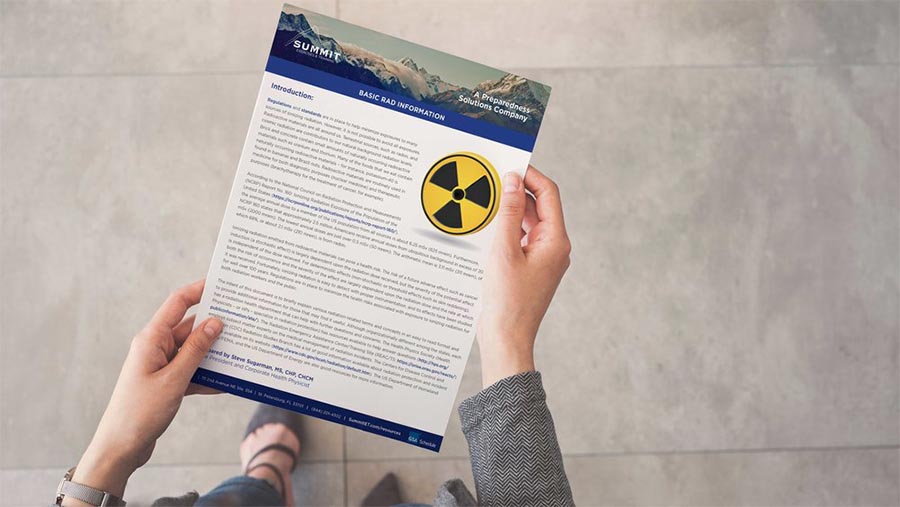
An expertly curated list of government radiation emergency information, tools, and resources.
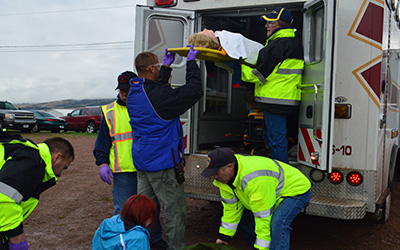
Initial Dose Magnitude Estimation for Individuals Involved in a Radiological Incident/Accident
Steve Sugarman originally wrote Early Internal and External Dose Magnitude Estimation in 2008 when serving as the Health Physics Project Manager at the Radiation Emergency Assistance Center/Training Site (REAC/TS), a response asset of the US Department of Energy, to provide general guidance for early estimation of radiation dose magnitude. Although not always possible, every effort was made to write in understandable terms so that the guidance could be used by a wide range of people. The document was posted on the REAC/TS website, and during my time at REAC/TS the document was periodically updated in an effort to keep it current and improve its usability – the most recent update to Early Internal and External Dose Magnitude Estimation being 2017.
In late 2017 Steve left REAC/TS to join SummitET where he is the Vice President of Operations and Corporate Health Physicist. Upon revisiting Early Internal and External Dose Magnitude Estimation, Steve realized new information that may be pertinent to the topic had become available. He then incorporated that information into an undated document: Initial Dose Magnitude Estimation for Individuals Involved in a Radiological Incident/Accident.
Initial Dose Magnitude Estimation for Individuals Involved in a Radiological Incident/Accident isn’t intended to provide methods for definitive dose calculation, but to provide methods one may consider using for initial dose estimation when trying to determine the potential magnitude of the radiation doses to individuals involved in a radiation incident/accident. As with any job, it’s advantageous to have multiple tools available to help with the task, but it’s up to the user to determine if the proper tool is being selected and to apply that tool correctly to any given situation. The tools/methods described in this document are in no way intended to take the place of established/validated internal dose assessment (urinalysis, whole body counting, etc.) or external dose assessment (selection of proper dosimetry, in-depth reconstructions, etc.) techniques, nor are they to be used for regulatory and/or occupational dose assignment. Each situation should be evaluated for the applicability of the described tools with an understanding of the strengths and weaknesses that are inherent in each of them.
This document is intended to provide general guidance and is not a peer-reviewed publication.
Early Dose Magnitude Estimation
Download this free resource document created by Steve Sugarman

Steve Sugarman
VP of Operations & Corporate Health Physicist
Note: The following document builds upon and updates information contained in a document written by Steve Sugarman when he was the Health Physics Project Manager at the Radiation Emergency Assistance Center/Training Site (REACT/TS) entitled “Early Internal and External Dose Magnitude Estimation.” The technical information contained in this update can be used to guide emergency responders, medical personnel, and others in occupational settings to conduct early radiation dose estimations.
Resources
Radiation Communication Resources
Initial Dose Magnitude Estimation for Individuals Involved in a Radiological Incident/Accident
After the normal questions asked by many medical care providers when treating a radioactively contaminated patient, such as “Is it safe for me to treat this patient?”
Meeting Strategic Communications Virtual Solutions Requirements during COVID-19 Response For Nuclear Power Plants and Offsite Response Organizations
Hybrid learning models for Nuclear Power Plants and Offsite Response Organizations to meet regulatory training requirements and beyond.